- Home
- Blog Details
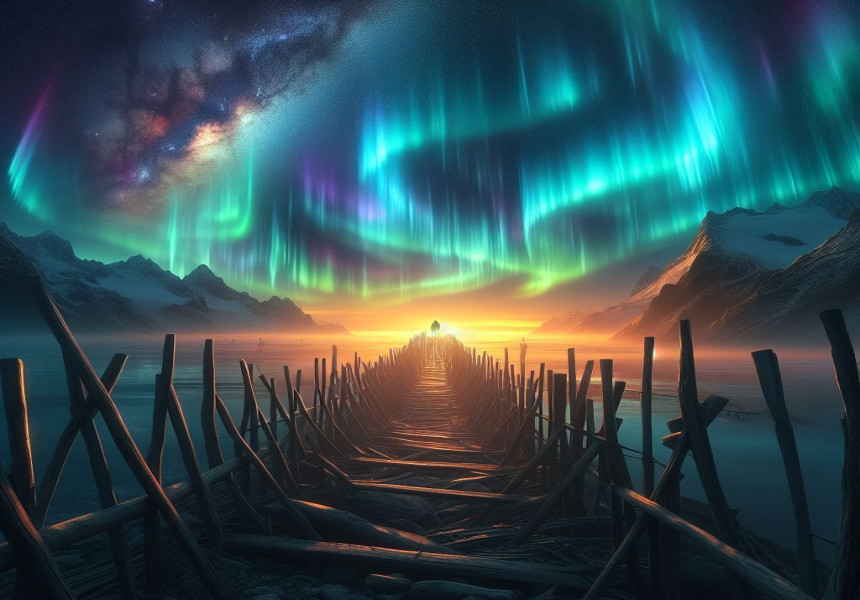
The enchanting spectacle of the northern and southern lights, known as auroras, has captivated the hearts of travel enthusiasts worldwide with their vibrant hues of green, red, and purple. However, hidden within the celestial canvas are two unique luminous phenomena—Steve and the "picket fence," often disguised as auroras.
Not precisely fitting the traditional aurora description, Steve and the picket fence exhibit mauve and white streaks, offering distinct forms of nocturnal radiance. Claire Gasque, a graduate student in physics at the University of California, Berkeley, has collaborated with researchers at the Space Sciences Laboratory (SSL) to shed light on the unique characteristics of these imposter lights.
Gasque proposes an intriguing hypothesis, suggesting that NASA should launch a rocket into the center of auroras to investigate and confirm her findings. While the realization of such a mission remains uncertain, the collaboration reflects the eagerness to unravel the mysteries of these unconventional celestial displays.
The increased occurrence of auroras, Steve, and the picket fence is attributed to the sun entering an active phase in its 11-year solar storm and coronal mass ejection cycle. Steve, denoting "Strong Thermal Emission Velocity Enhancement," and the picket fence, characterized by electric fields aligned with Earth's magnetic field, manifest in an upper atmospheric region farther south than the typical aurora formation.
In a paper published in Geophysical Research Letters, Gasque details the scientific underpinnings of the picket fence phenomenon, presenting her findings at the American Geophysical Union meeting in San Francisco on December 14. She highlights the potential to reshape our understanding of auroral light and energy dynamics in certain scenarios.
Brian Harding, an SSL assistant research physicist and co-author of the paper, commends Gasque's work, acknowledging its revelation of unconventional physics hinted at by the Steve spectrum. Gasque's research illuminates the role of parallel electric fields in explaining the distinctive spectrum observed in Steve, contributing to the evolving narrative of these extraordinary celestial occurrences.