- Home
- Blog Details
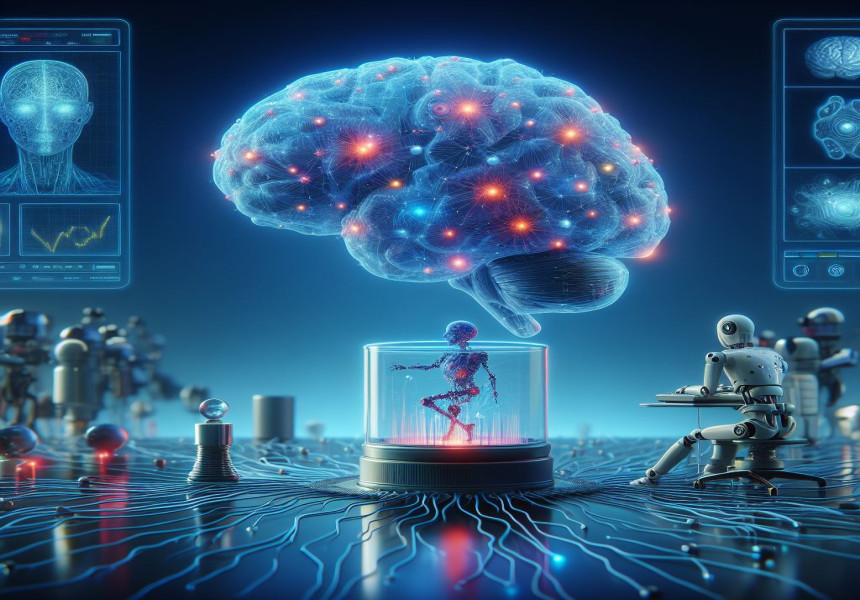
A biocomputing system composed of clusters of living human brain cells has demonstrated rudimentary speech recognition capabilities. The system, known as "Brainoware," utilized brain organoids—miniature structures formed from nerve cells grown in specific conditions—connected to a microelectrode array. Brainoware was tasked with identifying the voice of an individual among 240 audio clips featuring eight people pronouncing Japanese vowel sounds.
Lead researcher Feng Guo from Indiana University Bloomington describes the achievement as a proof-of-concept, emphasizing the preliminary nature of their success. Brain organoids, resembling mini-brains, were grown over two to three months, consisting of up to 100 million nerve cells. The organoids were then placed on a microelectrode array, forming the basis of the Brainoware system.
Despite initial accuracy rates of 30 to 40 percent, the organoids exhibited adaptive learning during two-day training sessions, ultimately achieving accuracy levels of 70 to 80 percent. The training involved exposing the organoids to spatially patterned sequences of signals derived from audio clips, with no feedback provided—a form of unsupervised learning.
Guo's team aims to address two major challenges faced by conventional AI: high energy consumption and the inherent limitations of silicon chips. Brainoware represents one approach within a broader exploration of biocomputing using living nerve cells. While researchers acknowledge the system's simplicity—focused solely on speaker identification rather than speech content—questions remain regarding the practicality and ethical considerations of utilizing brain organoids for AI tasks.
Titouan Parcollet at the University of Cambridge, specializing in conventional speech recognition, acknowledges the potential role of biocomputing in the long run. However, he cautions against assuming that brain-like structures are necessary to achieve the current capabilities of deep learning models, which excel in specific tasks. Guo's team acknowledges the need to address limitations, including the short lifespan of organoids, to harness their computational potential for AI computing.