- Home
- Blog Details
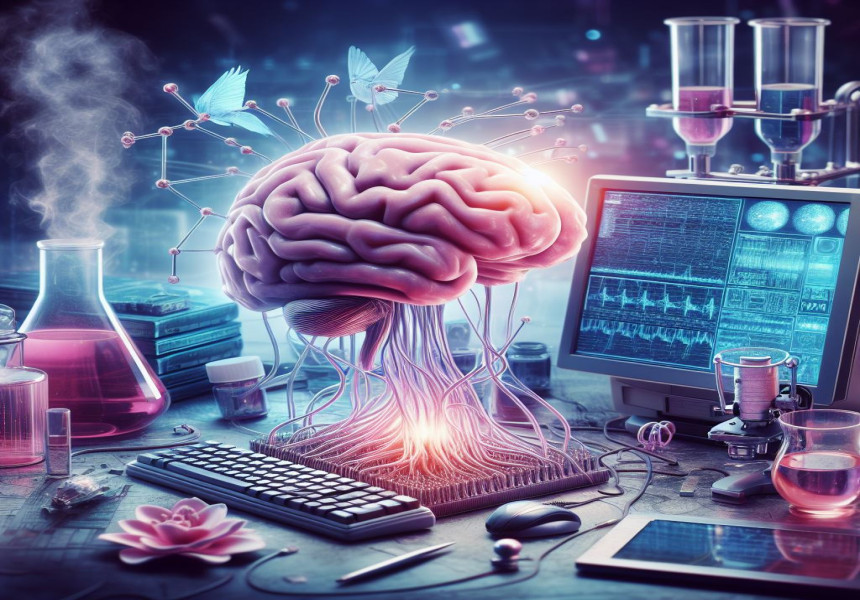
In a groundbreaking leap towards creating artificial minds, scientists have achieved a significant milestone by connecting lab-grown clusters of human brain cells, known as "brain organoids," to computer chips. This innovative amalgamation, referred to as Brainoware, demonstrated the ability to perform basic tasks such as recognizing spoken words. The fusion of brain organoids and computer chips opens new avenues in bio-computing, showcasing potential advancements that could lead to more efficient systems surpassing traditional computing models.
The process involved creating a brain organoid from stem cells, integrating it with a computer chip, and connecting the hybrid system to an AI tool. The results exhibited the system's capacity for processing, learning, and retaining information, establishing rudimentary speech recognition capabilities.
Feng Guo from Indiana University Bloomington expressed excitement about this first demonstration of utilizing brain organoids for computing, emphasizing the promising possibilities for biocomputing in the future.
Published in Nature Electronics, this research not only represents a significant step forward but also hints at the potential for more efficient bio-computing systems compared to conventional computers.
The research paper emphasizes that brain-inspired computing hardware seeks to emulate the structure and operational principles of the human brain, addressing current limitations in artificial intelligence technologies. While existing brain-inspired silicon chips are limited in fully replicating brain functions due to their reliance on digital electronic principles, Brainoware emerges as a bridge between artificial intelligence and organoids, referred to as "mini-brains" by Mr. Guo.
This proof-of-concept demonstrates the feasibility of leveraging biological neural networks within brain organoids for computing, opening doors to future innovations in the intersection of AI and organoid technologies.